What is kratom, and what does the science say about its safety?
Kratom is a leaf, not a lab product. Decades of use and more than $100 million in NIDA-funded research say the same thing: natural kratom has a low-risk profile, and the federal government is now testing its main compound as a treatment for opioid addiction.
Science videos
Watch the research explained
A tree from Southeast Asia
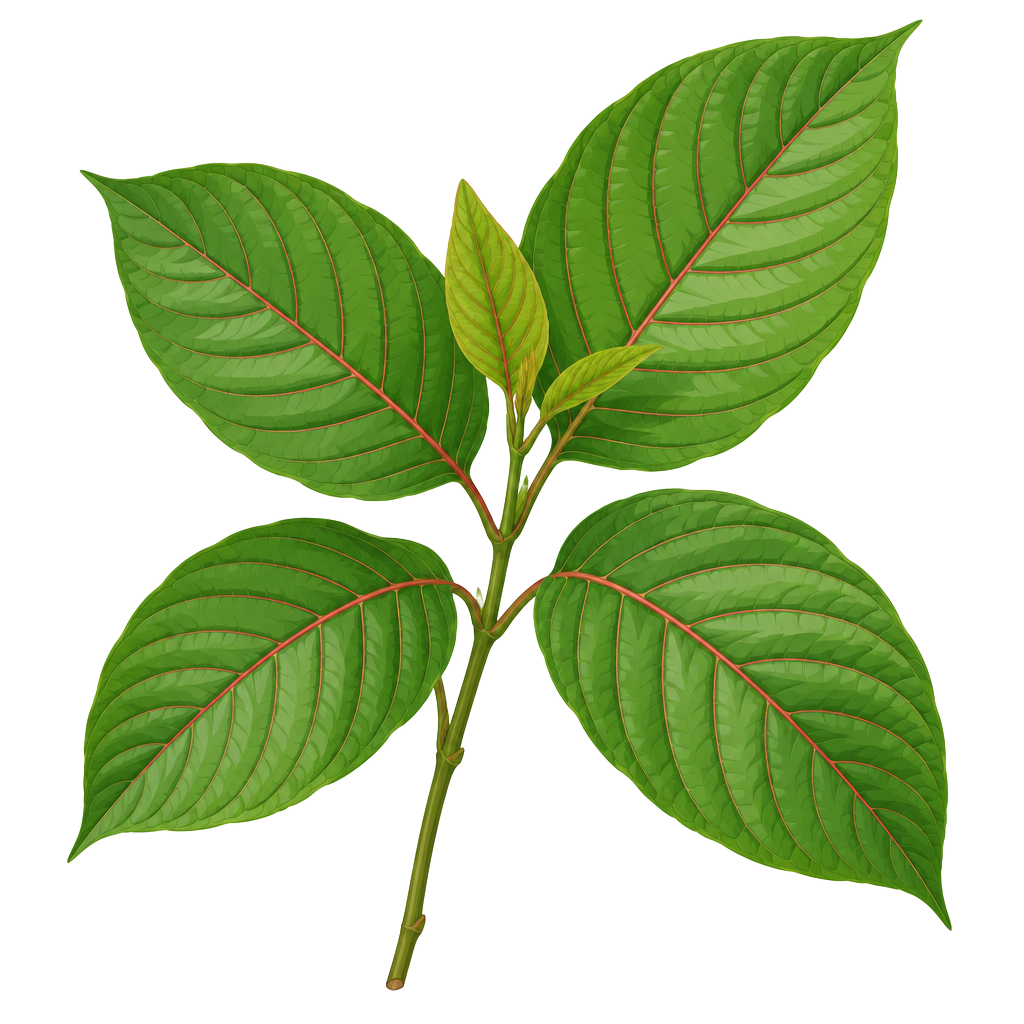
Kratom is the common name for Mitragyna speciosa, a tropical tree in the coffee family native to Indonesia, Thailand and Malaysia. For centuries, farm and field workers there have chewed or brewed its leaves for an energy lift and relief from everyday aches. In the United States, consumers use natural leaf kratom the way many people use coffee: for focus and energy, to take the edge off common pain and anxiety, and, for some, as a way to step away from prescription and illicit opioids.
About 1.7 million Americans aged 12 and older, or 0.6 percent, reported using kratom in the past year, according to the National Survey on Drug Use and Health cited by the National Institute on Drug Abuse (NIDA). Most say they use it for more than one reason: pain, energy, mood, or managing opioid withdrawal and cravings.
What is in the leaf
Kratom leaves contain a family of plant alkaloids. The main one is mitragynine. A second compound, 7-hydroxymitragynine (7-OH), appears only in trace amounts, produced by oxidation as the harvested leaves dry, and makes up less than 2 percent of the total alkaloids in a natural leaf product.
Mitragynine partially activates the brain's mu-opioid receptors, which is why kratom can ease pain. But NIDA's own summary draws the line that matters:
"Neither kratom leaves nor mitragynine appear to lead to respiratory depression."National Institute on Drug Abuse, Kratom research topic
Respiratory depression is the effect that makes opioid overdoses fatal. Mitragynine and 7-OH also act on adrenergic, serotonin and dopamine receptors, which helps explain the coffee-like stimulant effect at everyday servings. That pharmacology is why AKA has said for years that kratom is not an opiate and not a synthetic. It is a botanical that, like coffee and chocolate, touches receptor systems in the brain without behaving like a prescription opioid.
What the federal science says
NIDA
The National Institute on Drug Abuse funds research on kratom's potential to treat opioid use disorder and chronic pain. Its research page reports that a minority of consumers describe withdrawal symptoms, a smaller minority describe substance-use-disorder symptoms, and that withdrawal, where it occurs, is mild to moderate. A 2019 federal report found 11 kratom-associated deaths between 2011 and 2017, only two of which involved kratom alone; more than 200,000 opioid-related deaths occurred in the same period.
NIH, June 2026
On June 1, 2026, the National Institutes of Health announced that FDA had approved an Investigational New Drug application allowing the first randomized, double-blind, placebo-controlled Phase I safety trial of purified mitragynine in people, as a potential treatment for opioid use disorder. Preclinical studies by NIH's NCATS and NIDA and the University of Florida found no significant safety concerns across multiple doses.
"This IND is a major step toward expanding treatment options for millions struggling with opioid use disorder."Nora Volkow, M.D., Director, NIDA
FDA's own dose study
In its single ascending dose study of natural leaf kratom in human volunteers, FDA concluded that "kratom appears well tolerated at all dose levels," with subjects safely consuming up to 12,000 mg of pure leaf in a five-minute period without a serious adverse event. Most kratom products on the market deliver 175 mg or less per serving.
HHS, 2018
When FDA asked to place kratom in Schedule I, HHS Assistant Secretary for Health Brett Giroir withdrew the recommendation, citing "embarrassingly poor evidence" and a "failure to consider overall public health."
WHO, 2021
The World Health Organization's Expert Committee on Drug Dependence reviewed kratom and found insufficient evidence of harm to justify international control, keeping it under surveillance instead.
Reading death reports carefully
Headlines about "kratom deaths" rarely survive a close look. Forensic toxicology labs often do not separate mitragynine from 7-OH, cannot tell a natural leaf product from a chemically altered one, and frequently do not screen for the other drugs present. Most reported cases involve multiple substances. FDA itself acknowledges that kratom-associated deaths are rare and typically involve adulterated products or polydrug use. AKA's Advocate's Voice brief, Why Kratom Death Reports Are Unreliable, walks through the methodology problems, including those in the Tampa Bay Times "Deadly Dose" series.
The same care applies to liver claims. FDA's adverse-event database logged single-digit acute liver injury reports tied to kratom in each of 2018, 2020, 2022 and 2023, against several hundred per year for five acetaminophen products sold in the same convenience stores.